Living With Teak: Light, Grain and a Quiet Care Routine
Teak is not a printed surface. Its grain, pores and tone remain active participants in the work, changing subtly with light, environment and time.
A material with memory
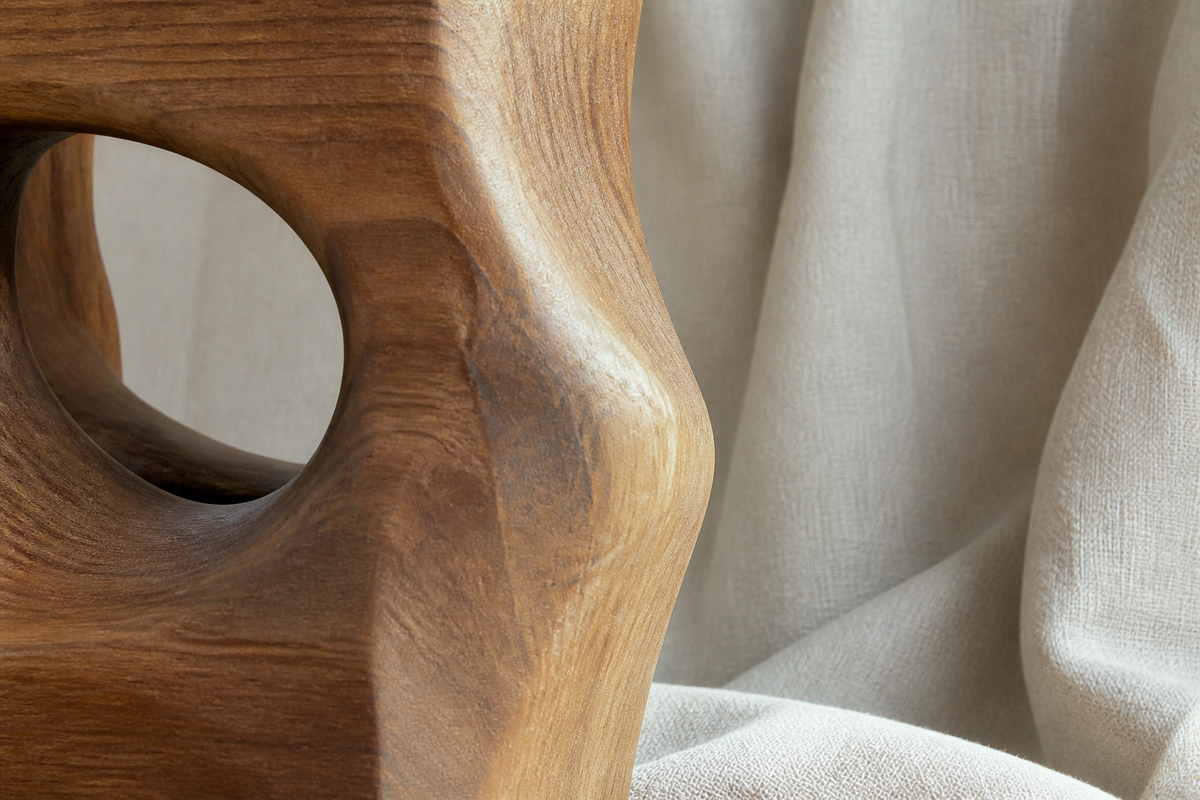
A carved teak sculpture carries evidence of growth and making at the same time. Long grain bends around a curve. End grain appears where a plane turns. Open pores catch a trace of shadow. Fine tool transitions become visible only when light moves across the surface. These variations are not interruptions to a uniform finish; they are the visual record that makes a solid-wood work individual.
Because the geometry is carved through real material, different faces can receive light and finish differently. One plane may look quieter at noon and more pronounced at dusk. A smoked or ebonized finish can deepen this effect without erasing the grain beneath it.
Why the same sculpture changes through the day
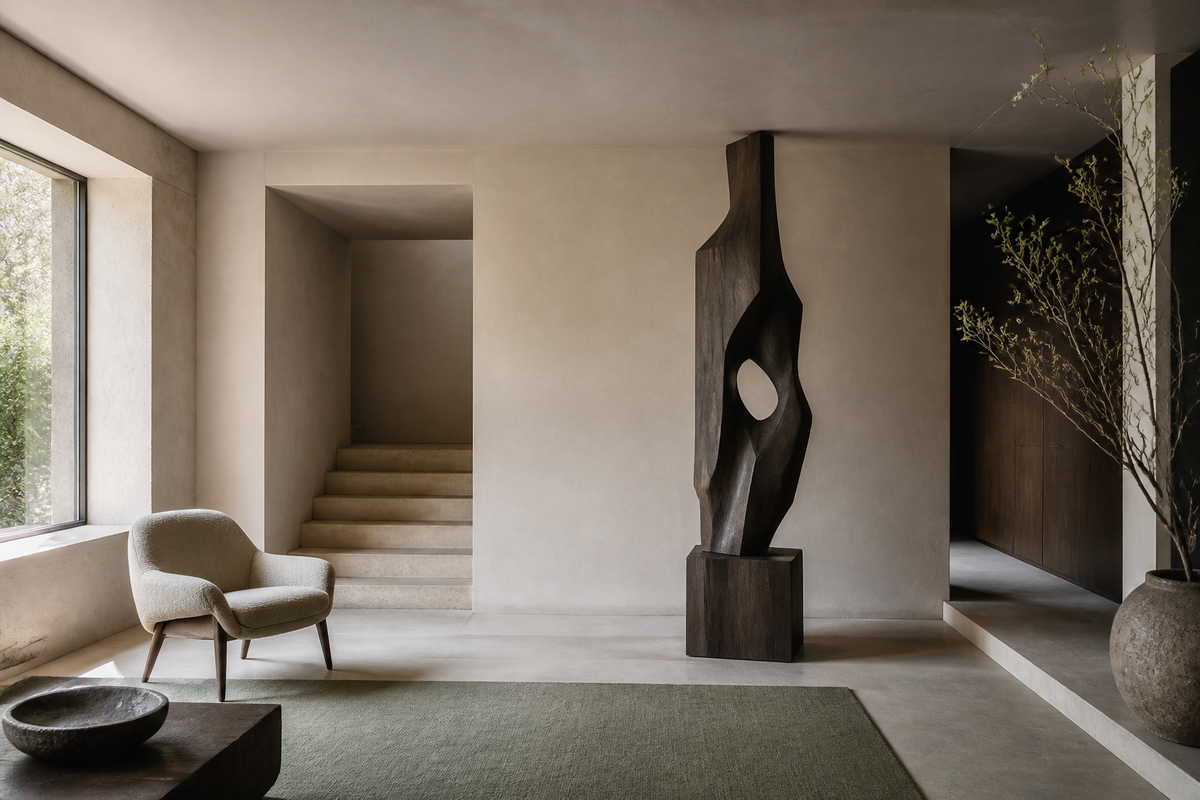
Directional daylight reveals relief. When a window sits to one side of the work, raking light describes edges, shallow tool marks and the depth of a void. Flat frontal light reduces those cues. This is why a sculpture can appear more architectural in the morning and more graphic in the evening, even though nothing about the object has changed.
A considered position allows this change without placing one face under prolonged, concentrated direct sun. Use bright ambient light or indirect daylight when possible. If the room receives strong sun, observe the path across the day and avoid a placement where a single surface repeatedly takes the full intensity.
Keep the environment steady
Wood responds to its surrounding moisture conditions. The practical implication indoors is simple: avoid abrupt environmental shifts. Do not place the work directly beside a radiator, fireplace, powerful air-conditioning outlet or other concentrated heat source. A stable, comfortable interior environment is preferable to repeated extremes.
This is especially relevant for large carved forms, where changes across the mass can be more consequential than on a small object. The aim is not a laboratory climate. It is consistency: a sensible position, no direct heat and no sudden transition between very different conditions.
The care routine should remain quiet
For routine dust, use a soft, dry, lint-free cloth. Follow the direction of the grain where it is visible and support the cloth so it does not catch on a sharp carved transition. For deep apertures or narrow clefts, a clean, soft brush can reach dust without forcing a cloth into the geometry.
Avoid water, household sprays, silicone polishes and general-purpose cleaners unless a product-specific care instruction explicitly calls for them. Adding a new coating can change sheen, color and the way dust collects. When a surface requires more than dry dusting, contact the seller or maker with a clear photograph before intervening.
Natural variation is part of the work
No two sections of teak present identical grain. Tone may shift between face grain and end grain, and between exposed and sheltered surfaces. These differences should be read together with the silhouette and carved planes, not judged as a defect against the uniformity of a synthetic surface.
At the product-review stage, look for honest detail photographs that show an identifiable edge, void or facet rather than a generic wood texture. That context helps you understand how the actual material belongs to the actual form.
A short annual review
Once or twice a year, look at the work in even daylight. Check that it remains stable on its intended base or mounting, that nearby heat and sun conditions have not changed, and that dust has not accumulated in hidden recesses. Monumental or wall-mounted works should be reviewed according to their confirmed installation requirements.
Good care is deliberately uneventful. Place the sculpture thoughtfully, keep the environment steady and clean it with restraint. The reward is not a surface frozen in time, but a material that continues to read as alive, tactile and specific.